Explore critical journals that analyze the visual poetry of the artworks in our collection and artists behind them.


The Art of Francisco Zúñiga
Jaz Zuniga – June 15th, 2026
Featuring the Art of Francisco Zúñiga is an honor for Oasis Auctions LLC and as the month comes to an end, we’ve reflected on the artistic techniques and visual poetry seen within his compositions. The figurative works of Francisco Zúñiga occupy a significant place within twentieth-century Latin American art and have garnered sustained attention from critics, curators, and art historians alike. Across sculpture, drawing, and printmaking, Zúñiga employed established Western artistic conventions while simultaneously centering Indigenous and Pre-Columbian-inspired subjects, creating works that evoke deep emotion and transcend simple categorization. Through his sensitive treatment of materials such as bronze, stone, pencil, and pastel, the artist imbued his figures with a quiet monumentality and psychological depth. Rather than presenting explicit narratives, Zúñiga's compositions evoke a sense of contemplation and ambiguity, inviting viewers to consider the cultural identities, histories, and lived experiences embodied by his subjects. By repurposing and stylizing Western artistic conventions, Zúñiga subtly suggests narratives that lie behind the enigmatic stories of his Indigenous subjects while fostering an atmosphere of emotional resonance and mystery.
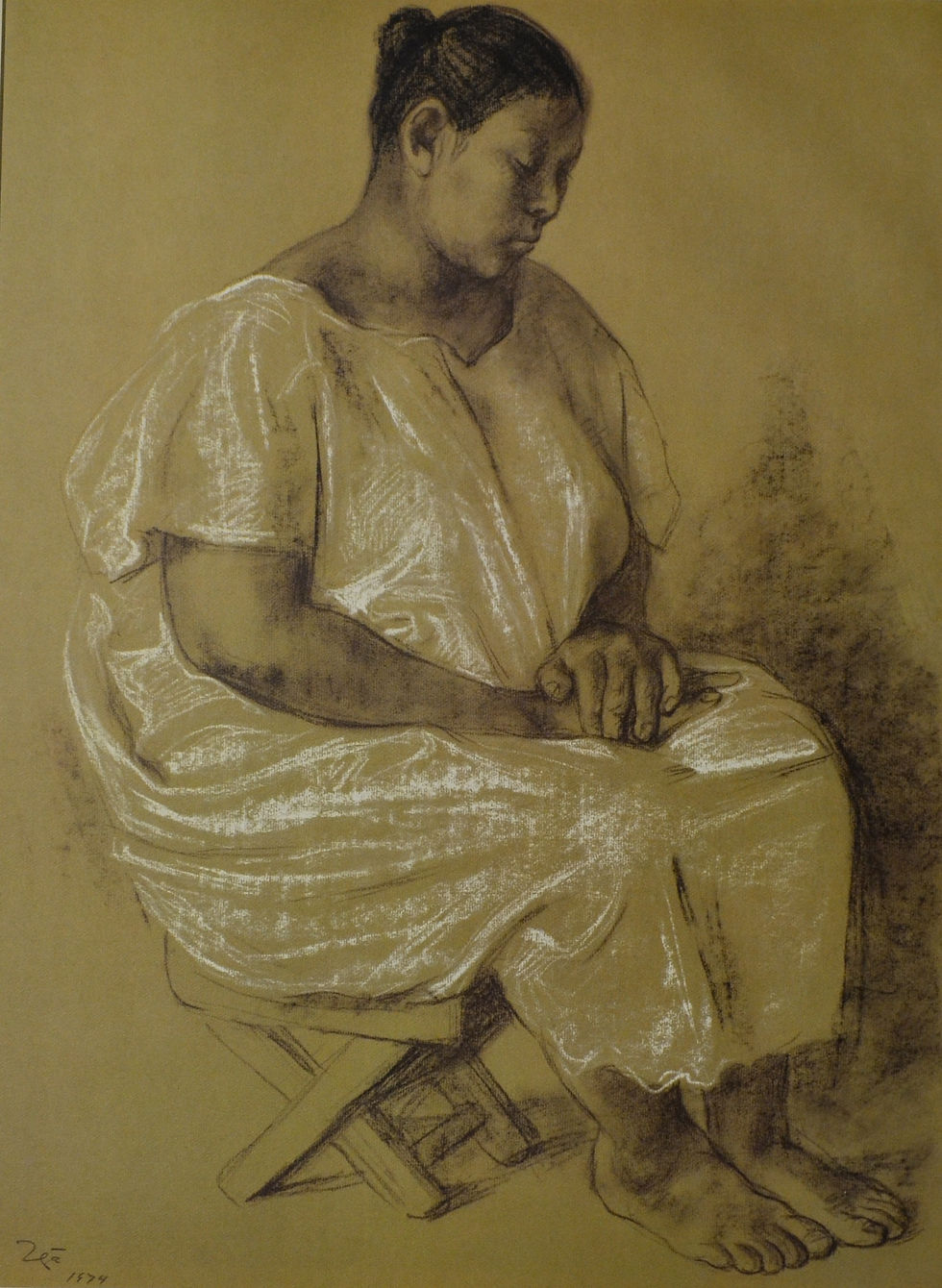
In the artwork titled, Martha (1974) (e.g., Figure 1) , a beautiful woman dressed in a simple Oaxacan tunic gazes downward with an air of detachment while seated on a small handcrafted wooden bench. She appears to be waiting, resting, or perhaps simply contemplating thoughts unknown to the viewer. The style of the work is soft, yet it retains the appearance of having been sketched with immediacy. This fascinating textural quality, visible throughout many of Zúñiga’s drawings, paintings, lithographs, and even his bronze and stone sculptures, brings attention to the concept of imperfection—not in the sense that the works appear unfinished, but rather that they convey the impression of having been recently touched by human hands. It is as though the artist had completed the work only moments before the viewer entered the exhibition space, with external textures reminiscent to those seen in pre-Columbian art like the Tlatilco Figurines (1200-900 B.C.E) of the late Pre-Classic era of ancient Mexican history. This textural approach offers insight into the emotional and psychological worlds of his female subjects, suggesting an artist deeply familiar with the cultural experiences and lived realities of Indigenous peoples throughout Mexico and Latin America.
This artistic sensibility is likewise evident in El Peinado (1974), where an Indigenous woman, perhaps of an older generation, peers intently at the scalp of a younger woman, arranging her hair for an event or occasion unknown to the viewer. The “timelines of labor” almost emerge as a recurring theme, manifesting in his contemplative female figures, in the tactile surfaces of the works themselves, and ultimately within the exhibition space—where viewers are likewise engaged in the laborious task of deciphering the stories, emotions, and intentions embodied by the subjects.
Figure 1, "Martha," 1974, Offset Lithograph on Arches Wove Paper, Oasis Auctions LLC Archive 2026
The experience of viewing an artwork by Francisco Zúñiga differs significantly from that of encountering a Neoclassical nude by, say, Laurent-Honoré Marqueste. The mystery of Zúñiga’s art does not reside in a prescribed narrative, mythology, heroic backstory, or romanticized tale of triumph. Rather, it emerges through the quiet ambiguity of the subject herself. Who is she? Where has she come from? Where is she going? Why does she appear to feel a particular emotion? Is she feeling anything at all? Is she bored, exhausted, frustrated, or melancholic? The most compelling works of art often leave viewers with questions, and Zúñiga’s works excel in this regard.
By drawing upon Western artistic traditions to represent Indigenous subjects, Zúñiga constructs a visual language that is both familiar and deeply personal, allowing his figures to transcend specific narratives and assume a broader human significance. The quiet mystery that permeates works such as Martha and El Peinado encourages viewers to engage actively with the artwork, searching for meaning within the subject’s posture, expression, and presence. Ultimately, the enduring power of Zúñiga’s art lies not in the answers it provides, but in the questions it inspires, reaffirming his place as one of the most compelling figurative artists of twentieth-century Latin American art.
